Why Colombia's Caribbean Coast Is Entering a New Investment Cycle
There is a phase in real estate that tends to go unnoticed by the broader market — when infrastructure is already in motion, when connectivity begins to improve, and when the foundations of future demand are being quietly established, but before pricing fully reflects that transformation.
A region in transition. Over the past few years, the coastal corridor between Barranquilla and Cartagena has begun to show clear signals of structural change — driven not by a single project, but by the convergence of expanding urban influence from Barranquilla, strengthening tourism dynamics in Cartagena, increasing interest in secondary coastal locations, and gradual improvements in infrastructure and logistics.
Together, these elements are shaping what can be understood as a new stage in the region's development, one that tends to precede sustained real estate appreciation.
Infrastructure as a value catalyst. Rafael Núñez International Airport is currently undergoing a major expansion, increasing capacity from 7.7 to 11 million passengers, with financing already secured. A second airport project for the region is under evaluation, with capacity for 17 million passengers. The port of Cartagena, operated jointly by APM Terminals and COMPAS with a $200M investment, is already one of the busiest container ports in South America. The new Río Córdoba port terminal — approved in April 2026 with a $82M investment and 30-year concession — is reinforcing logistics capabilities along the corridor.
These are not isolated initiatives. They form part of a broader pattern: as infrastructure becomes visible, uncertainty decreases and value begins to consolidate.
Growing international interest. As these structural improvements take shape, international attention is naturally increasing. Coastal regions with improving accessibility, natural assets, and relatively early-stage pricing tend to attract a more diverse buyer profile over time. Events such as Salinas Fest 2026 reflect a growing global awareness of this coastline, particularly in segments linked to lifestyle, sports, and second-home ownership.
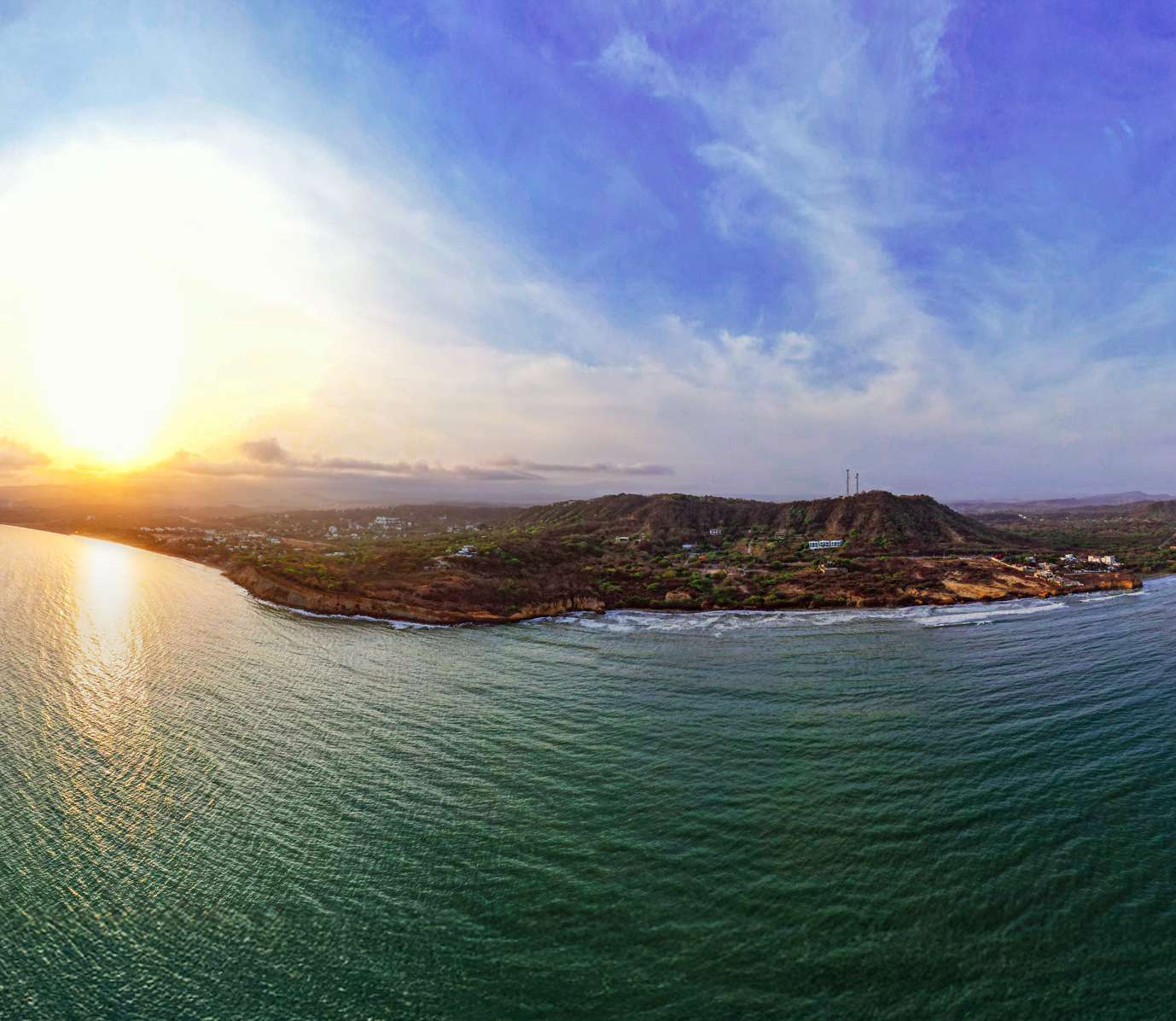
Market dynamics: from consolidation to expansion. Cartagena continues to consolidate its position as a high-end and internationally recognized destination. Santa Marta maintains strong demand in the short-term rental segment. Barranquilla is expanding as a business and urban hub. Between these established nodes, the coastal corridor connecting them is beginning to emerge as a natural expansion zone.
The role of planned developments. Rather than high-density construction, there is a growing shift toward planned, lower-density projects that integrate infrastructure, environment, and long-term vision. Projects such as Villa Mediterráneo illustrate this approach — integrated marina infrastructure with Ronáutica, a low-density master plan across an extended beachfront, and architectural direction by Villarroel Torrico (Puente Romano, Marbella).
Timing within the cycle. In real estate, value is not defined solely by location, but by moment of entry within the development cycle. Early phases reflect limited visibility, higher perceived uncertainty, and pricing that has not yet incorporated future infrastructure. As projects advance and surrounding areas consolidate, those initial conditions begin to shift.
Colombia's Caribbean coast is not an emerging story in the traditional sense. It is a region with established cities, growing connectivity, and increasing international visibility, now entering a new phase of consolidation and expansion. The key consideration is not only where value exists today, but how that value may evolve as underlying conditions continue to develop.