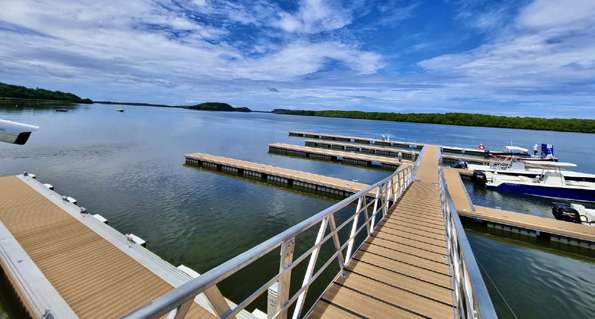
How Infrastructure Changes Value in Villa Mediterráneo
Most beachfront developments compete on location. Very few redefine the nature of the asset itself. Villa Mediterráneo introduces an additional layer: a marina, a nautical club, and a curated beachfront environment, set along 1 km of private beach and structured as a four-phase master development.
Ronáutica: operational structure and international standards. The marina at Villa Mediterráneo is being developed with the involvement of Ronáutica, a Spanish firm with more than three decades of experience in the design, construction, and operation of marinas. Their track record across Europe and Latin America, along with internationally recognized certifications such as ISO 9001 and ISO 14001, brings an important layer of operational credibility. For investors, this introduces a level of execution certainty that is not common in early-stage coastal developments.
Beyond infrastructure: the nautical component. In addition to the marina, the project incorporates a nautical club concept — structured access to boating, water-based activities, and a social and recreational layer tied to the sea. This type of infrastructure is still limited in the Colombian Caribbean and tends to attract a more specific buyer profile, typically associated with higher purchasing power and lower turnover profiles.
Amenities as demand drivers. The project also integrates a beach club environment, including a chiringuito concept and a broader set of amenities. Rather than focusing on density, the approach is based on curation and spatial quality. From an investment perspective, these elements are not incidental — they contribute to rental attractiveness, occupancy stability, and overall asset positioning.
Phase positioning: where value is captured. In real estate development, pricing evolves alongside execution. Phase 1 typically reflects early-stage conditions: limited visibility, higher perceived risk, initial market entry. Subsequent phases incorporate construction progress, validated demand, and reduced uncertainty. In a four-phase master development, this transition becomes even more relevant, as each phase reflects a different level of consolidation and market confidence.
In projects with clear differentiators, this transition often results in a widening gap between entry pricing and later-stage valuation. This is where early positioning becomes relevant. Villa Mediterráneo combines several of these differentiators: integrated marina infrastructure, low-density beachfront land, 1 km of private coastline, and a structured, multi-phase development strategy.
Context and timing. The project is positioned within a coastal corridor undergoing gradual transformation, supported by infrastructure improvements and increasing connectivity. At this stage, pricing still reflects an earlier phase of that transition. As execution becomes visible and the surrounding area consolidates, value recognition tends to follow progressively.
Villa Mediterráneo is not defined only by its location, but by the integration of infrastructure, planning, and long-term positioning. For investors, the key variable is not only the asset itself, but when in the development cycle the entry takes place. Projects of this nature tend to reveal their value progressively — but positioning is defined early.